Custom Lighting for Professional Ambiance
Request A Custom Quote
Decorative Solutions for Dynamic Venues Conference halls, banquet rooms, and lobbies each demand a distinct atmosphere.
Our custom decorative lighting—from statement chandeliers to integrated wall sconces—provides a cohesive design language that adapts to your venue’s diverse programming with elegance and purpose.
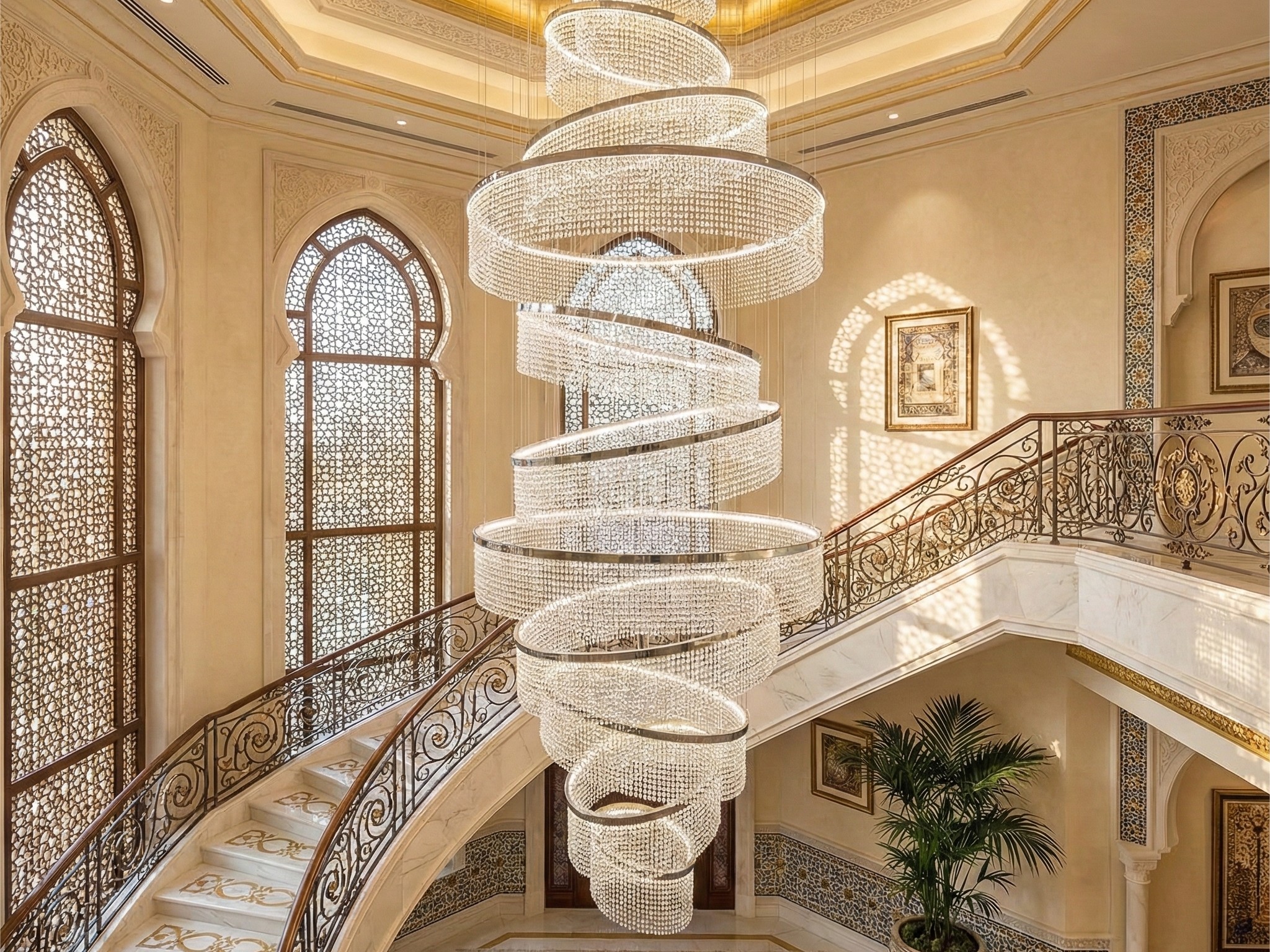
Hospitality Lighting
View DetailsWedding & Banquet Lighting
View DetailsConference & Venue Lighting
View DetailsSales Gallery Lighting
View DetailsVilla & Residence Lighting
View DetailsRestaurant & Bar Lighting
View DetailsRetail & Boutique Lighting
View DetailsRetail & Boutique Lighting
View DetailsRetail & Boutique Lighting
View DetailsRetail & Boutique Lighting
View DetailsRetail & Boutique Lighting
View DetailsRetail & Boutique Lighting
View DetailsThe Decorative Lighting Guide for Conference & Venue Spaces: Where Design Meets Purpose
Light in a space dedicated to gathering is more than a utility; it is the unseen architect of atmosphere, the silent narrator of brand, and a fundamental tool for shaping human experience. While functional lighting ensures visibility, it is decorative lighting that imbues a conference center, performing arts hall, or multi-use venue with its unique character and emotional resonance.
This guide is crafted for architects, interior designers, venue operators, and developers who understand that the ceilings and walls of a professional space are not merely boundaries, but canvases for expression. We move beyond lumens and wattage to explore how thoughtfully curated and custom-crafted decorative fixtures—chandeliers, pendants, sconces, and sculptural installations—can transform a venue from a passive container into an active participant in every event it hosts.
Here, we will navigate the journey of specifying decorative lighting that truly works. We’ll explore how to select fixtures that tell a cohesive story across diverse zones, demystify the key technical and aesthetic decisions, outline a proven collaborative process with manufacturers, and ensure your investment remains impactful and beautiful for decades. This is your blueprint for lighting that doesn’t just illuminate space, but defines it.
Part 1: Beyond Illumination: How Decorative Lighting Defines a Venue’s Character
In the realm of conferences and prestigious venues, lighting must do more than merely dispel darkness. Decorative lighting acts as the “visual voice” of the architecture, performing three critical functions that generic, functional lighting cannot achieve:
Establishing Professional Tone & Authority: The first impression in a boardroom or auditorium foyer is often set by a lighting fixture. A well-proportioned, meticulously crafted chandelier or a series of refined wall sconces communicates stability, competence, and attention to detail. It silently assures clients and attendees that they are in a space where serious work and important conversations happen.
Creating Unique Spatial Identity & Memory: In a competitive market, venues need to be memorable. A signature decorative installation—be it an abstract kinetic sculpture in the atrium or a dramatic, cascading piece in the ballroom—becomes a landmark. It gives the space a name and a face, featuring prominently in marketing materials and becoming a talking point that distinguishes it from bland, utilitarian competitors.
Directing Emotion & Behavior: Light shapes how we feel and act. Warm, softly diffused light from decorative pendants in a networking lounge encourages conversation and relaxation. In contrast, focused, dramatic illumination from a linear feature piece can create a sense of procession and ceremony in a main corridor. Decorative lighting allows you to subtly choreograph the visitor’s journey and emotional response throughout the venue.
Part 2: Curating a Cohesive Narrative: Selecting Styles for Different Zones
A successful venue tells a cohesive story. Your decorative lighting should be curated like a collection, with each piece contributing to the narrative of its specific zone while belonging to the same visual family.
Grand Entrances & Atriums (The Statement): Here, lighting must command attention and set the overarching theme. This is the place for large-scale custom chandeliers, monumental sculptural installations, or impressive clustered pendants. The style here—whether sleek modern, timeless classic, or organically inspired—becomes the venue’s defining aesthetic signature.
Conference Auditoriums & Main Halls (Focused Grandeur): While functionality is key (e.g., no glare on screens), decorative elements integrate purpose. Architectural cove lighting that grazes walls, tailored linear fixtures following balcony edges, or substantial yet optically controlled central fixtures add layers of sophistication without compromising on the rigorous needs of presentations and performances.
Pre-Function Areas & Lounges (Social Catalyst): These spaces thrive on energy and interaction. Lighting should be inviting and dynamic. Consider groupings of smaller decorative pendants at varying heights, artistic wall sconces that provide both ambient and accent light, and statement floor lamps in seating clusters. This creates intimate “sub-spaces” and encourages mingling.
Corridors & Transition Spaces (Rhythm & Guidance): Often overlooked, these areas offer a chance for rhythm and discovery. A repeating series of distinctive wall sconces or integrated niche lighting can transform a simple hallway into a gallery-like experience, gently guiding movement while reinforcing the overall design language.
Part 3: The Art of Specification: Key Considerations for Decorative Fixtures
Selecting the right decorative fixture requires a balance of artistic vision and practical rigor. Move beyond just the image and interrogate these key aspects:
Scale & Proportion: The Golden Rule: A fixture must feel intrinsically connected to the volume of the space. Use detailed 3D renderings and scaled drawings to visualize the piece in situ. Consider not just width and height, but also its visual weight and the negative space around it.
Materiality & Finish: The Tactile Experience: The choice of brass, bronze, powder-coated steel, glass, or crystal defines both the look and the longevity. Consider the atmosphere: warm metals for hospitality, cool finishes for modern edge. Evaluate finishes for durability in high-touch areas and ease of cleaning.
Light Quality & Integration: How It Glows: How does the fixture emit light? Is it a direct downward glow, a soft upward wash, or a combination? Ensure the light sources (LED modules) are of high quality with excellent color rendering (CRI >90) and appropriate color temperature (2700K-4000K) to make people and interiors look their best. Dimmability is non-negotiable for scene setting.
Serviceability & Access: Design for the Future: Beauty should not come at the cost of practicality. Ask: How are light sources replaced? Is specialized equipment needed for cleaning? A good design allows for easy, safe maintenance without requiring complex disassembly, ensuring the fixture remains beautiful for its entire lifespan.
Part 4: The Collaborative Journey: From Vision to Flawless Installation
Bringing a custom decorative vision to life in a complex construction project demands a partnership built on clear process and expertise.
Phase 1: Conceptual Alignment & Feasibility: Share architectural plans, interior design concepts, and inspiration. The manufacturer should provide initial feedback on scale, style, and budgetary feasibility, ensuring the vision is grounded in reality from the start.
Phase 2: Design Development & Visualization: This is the core creative and technical phase. Expect detailed 3D models, photorealistic renderings from multiple viewpoints, and physical material samples (finishes, glass, crystal). This iterative stage is for refining every visual and material detail until the design is perfect and approved.
Phase 3: Engineering & Prototyping: Once the design is frozen, it moves into technical engineering for structure, weight, fixing details, and electrical integration. For complex or one-of-a-kind pieces, a full-scale prototype or a critical section mock-up is essential to verify craftsmanship, assembly logic, and final appearance under light.
Phase 4: Manufacturing & Pre-Installation Coordination: Production is scheduled in sync with the construction program. The manufacturer provides detailed installation drawings, rigging points, and interface details to the main contractor. They act as a resource to solve any on-site coordination issues that arise.
Phase 5: Installation Supervision & Final Focusing: For significant installations, having the manufacturer’s technician on-site for the initial installation is invaluable. They ensure the piece is assembled correctly and safely. After installation, they perform the final “focusing”—adjusting any directional elements and fine-tuning the visual effect.
Part 5: Ensuring Lasting Impact: Maintenance, Longevity & Adaptive Design
The true test of decorative lighting is how it endures. Plan for its life beyond the opening ceremony.
Developing a Proactive Maintenance Plan: Work with the manufacturer to create a simple maintenance schedule and guide. This should cover regular dusting, safe cleaning methods for specific materials, and the recommended interval for professional inspection of electrical components and structural integrity.
Designing for Serviceability & Modularity: The best fixtures are designed with maintenance in mind. This means tool-less access to LED modules, modular components that can be individually replaced, and standard-sized parts to avoid future obsolescence. This dramatically reduces long-term costs and downtime.
Considering Future Adaptability: Spaces evolve. Consider whether a large chandelier could be re-configured if the room layout changes, or if additional matching sconces can be produced years later. Choosing timeless design principles over fleeting trends also protects the long-term relevance of your investment.
Let Design Lead the Way
The most successful conference centers and venues are those where every element, including the light that falls from above, is intentional. Decorative lighting, when approached as an integral part of the architectural and experiential narrative, ceases to be an accessory and becomes the soul of the space.
This guide has mapped the journey from inspirational concept to enduring reality. The final, crucial step is choosing a manufacturing partner who respects the artistry of design as much as the science of execution—a partner who sees not just a fixture, but the role it plays in your venue’s story. Ready to write that story with light?
Explore Our Portfolio of Venue Lighting
See how decorative design shapes professional spaces.
Begin a Design Dialogue
Connect with our team to discuss the character of your next space.
Table Of Content
Part 1: Beyond Illumination: How Decorative Lighting Defines a Venue’s CharacterPart 2: Curating a Cohesive Narrative: Selecting Styles for Different ZonesPart 3: The Art of Specification: Key Considerations for Decorative FixturesPart 4: The Collaborative Journey: From Vision to Flawless InstallationPart 5: Ensuring Lasting Impact: Maintenance, Longevity & Adaptive DesignLet Design Lead the Way